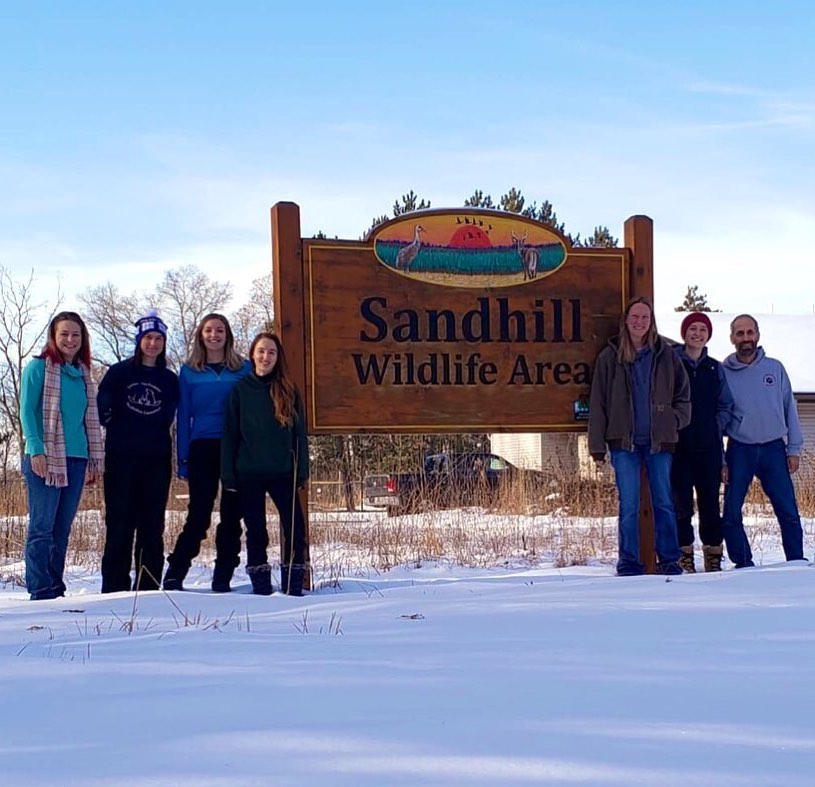
In December 2019, with the help of funding from the Animal Welfare Institute, we spent an amazing two weeks in Wisconsin, USA conducting fieldwork. We focused on one wolf pack territory and after scouting the area for field signs (tracks, scat, urine) we deployed a mixture of CARACALs, SM3, and SM4 acoustic detectors in the forest. The first few days were definitely tough as we felt like we were always one step behind the wolves’ movements and had to constantly change the locations of the detectors. The long days and brainstorming paid off though as we eventually managed to record lots of animal vocalisations, and were able to locate wolves and coyotes on several occasions.
Here’s an example of wolves howling that we recorded during this field trip:
Once we’d started to localise the animals, we put out camera traps (kindly lent to us by NatureSpy) to try to confirm their presence in the area. Although we didn’t capture any wolves on the cameras, we did capture this nice video of a coyote:
We were able to use the recordings to compare the sensitivity and precision of the cheaper, custom CARACAL recorders to the more expensive SM recorders. Overall, the CARACALs were less sensitive, detecting only 47.5% of wolf, 55% of coyote, 65% of barred owl and 82.5% of dog vocalisations detected by the paired SMs. However, when the same vocalisations were detected on both recorders, localisation was comparable, with no significant difference in the precision or maximum detection ranges. Low-cost recording equipment can be used effectively for acoustic localisation of both wild and domestic animals. However, the lower sensitivity of the CARACALs means that a denser network of these recorders would be needed to achieve the same efficacy as the SMs. Deploying a greater number of cheaper recorders increases the labour time in the field and the quantity of data to process and store. Thus, there is a trade-off between cost and time to be considered. You can read the full paper here: https://doi.org/10.1071/WR21089.
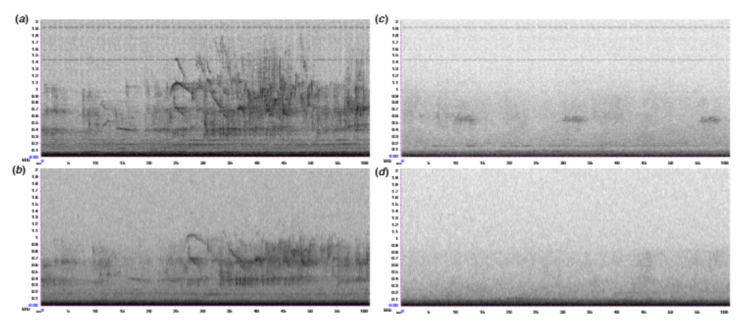
In keeping with my research interests of how domestic dogs affect wildlife, we also used the recordings from Wisconsin to look at the vocal interactions between farm dogs, wolves and coyotes in the area. We found lots of instances of these three species responding to each other:
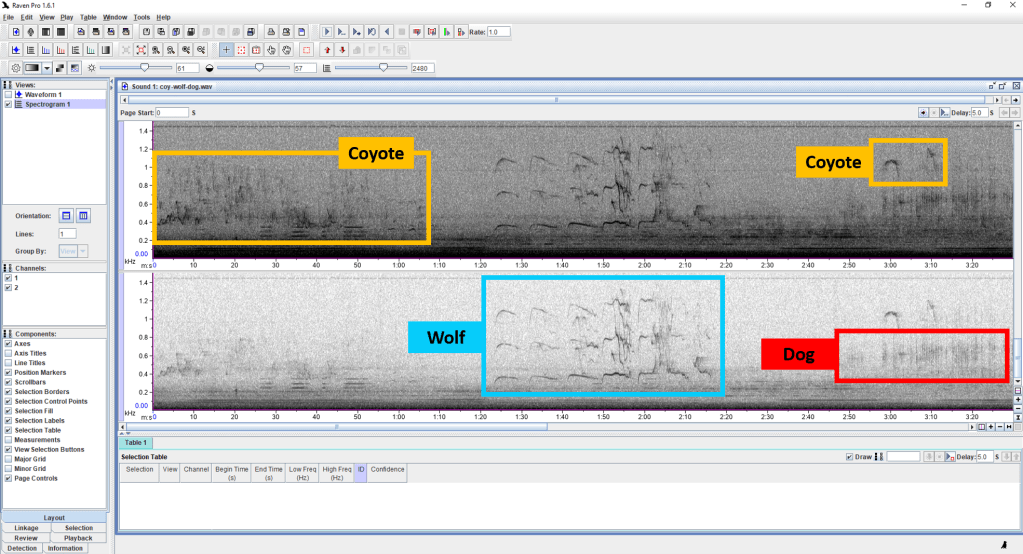
You can listen to this clip here:
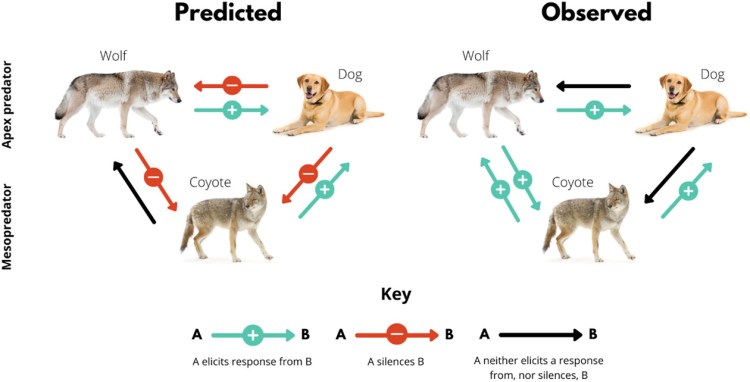
We were curious about these vocal relationships between wolves, coyotes, and dogs. These species have an unbalanced triangle of risk: coyotes, as mesopredators, are at risk from both apex-predator wolves and human-associated dogs, while wolves fear dogs, and dogs may fear wolves as apex predators or challenge them as intruders into human-allied spaces. Thus, we predicted that risk perception would dictate vocal response with wolves and dogs silencing coyotes as well as dogs silencing wolves. Dogs, in their protective role of guarding human property, would respond to both. Against our expectation, silencing did not occur. Instead, coyotes were not silenced by either species: when hearing wolves, coyotes responded at greater than chance rates and when hearing dogs, coyotes did not produce fewer calls than chance rates. Similarly, wolves responded at above chance rates to coyotes and at chance rates when hearing dogs. Only the dogs followed our prediction and responded at above chance rates in response to both coyotes and wolves. Thus, instead of silencing their competitors, canid vocalizations elicit responses from them suggesting the existence of a complex heterospecific communication network. You can read the full paper here: https://doi.org/10.1002/wlb3.01226.