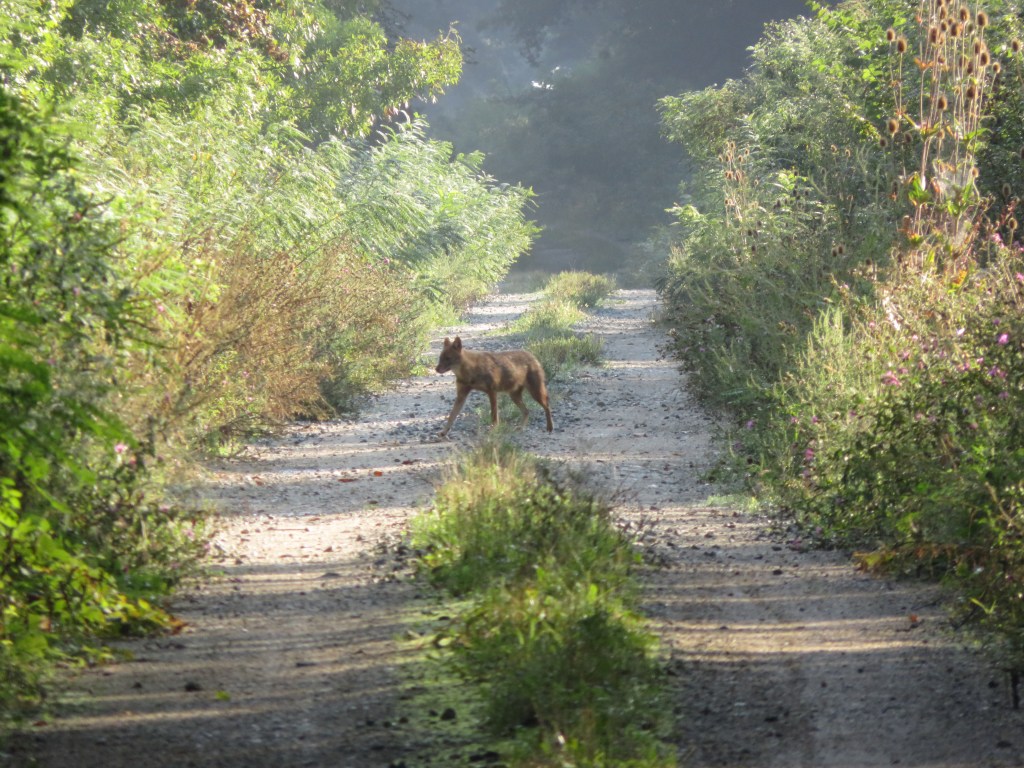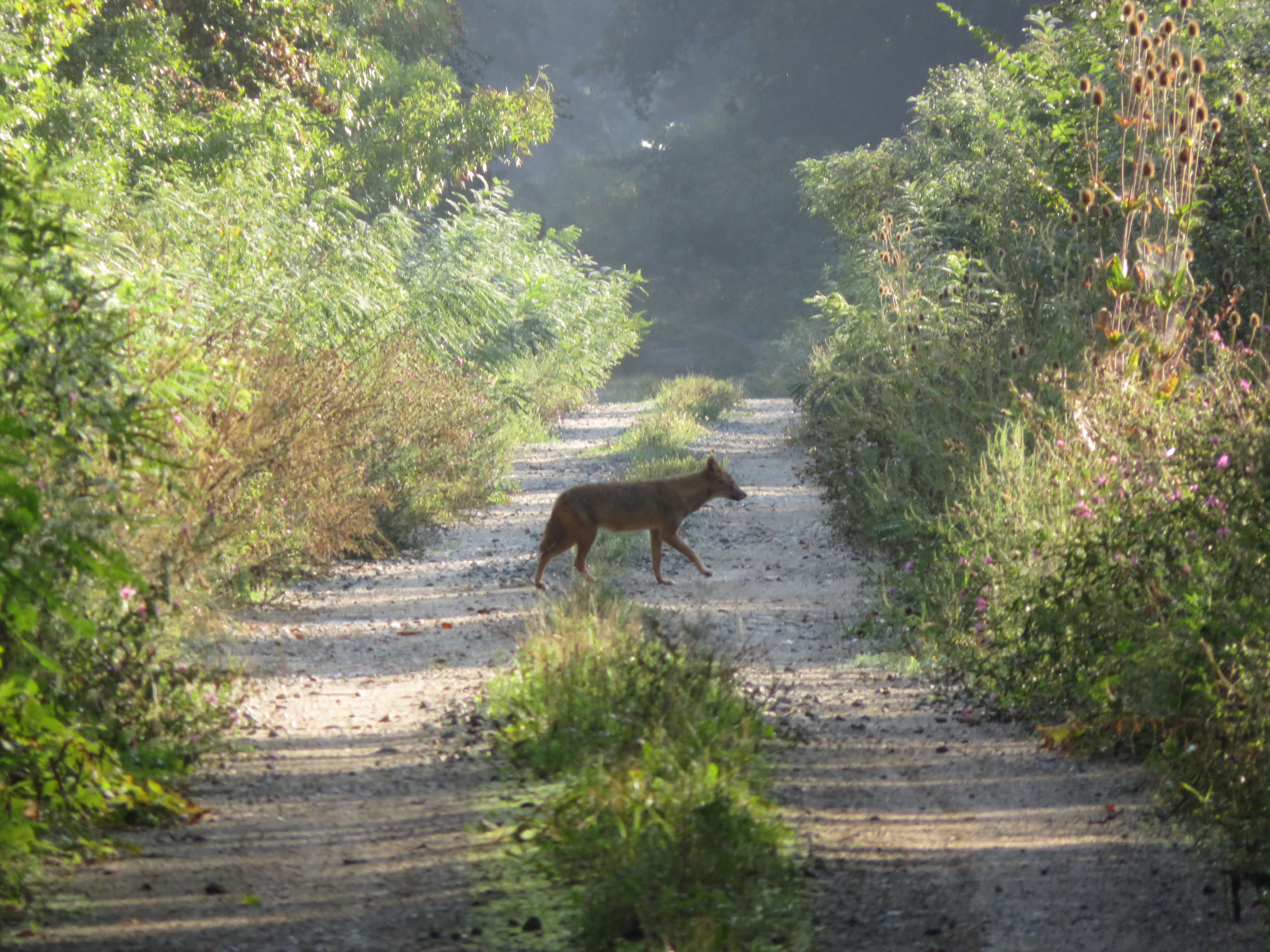
With support from Fauna & Flora, we spent 2 weeks in August 2021 recording golden jackals (Canis aureus) in the Parcul Natural Lunca Mureșului, Romania.
The fieldwork element was conducted by myself and Lizzie Bru with help from the Park’s rangers. We had a chaotic couple of weeks cycling around deploying and checking our acoustic recorders in all weathers and times of day, but it was definitely worth it! From our very first night when we conducted our first ever jackal howling survey, we were treated to the crazy and eerie sound of jackals howling. In fact, we heard jackals either in person or on our recorders every night of the survey! Here’s a sneak peak of some jackals howling:
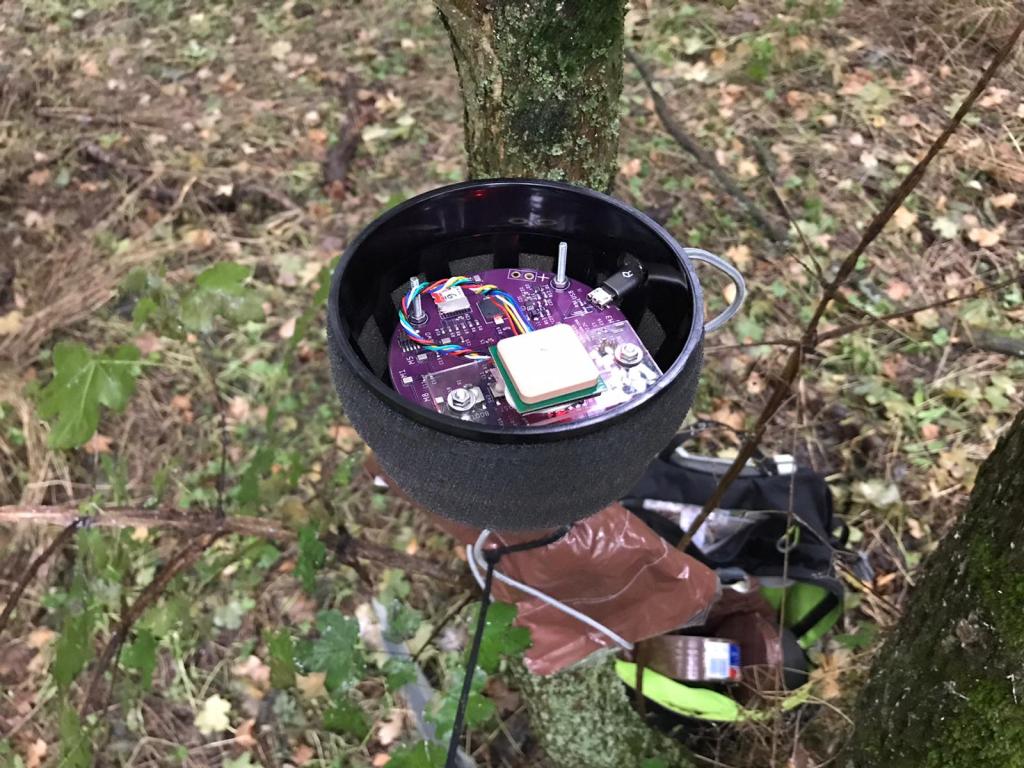
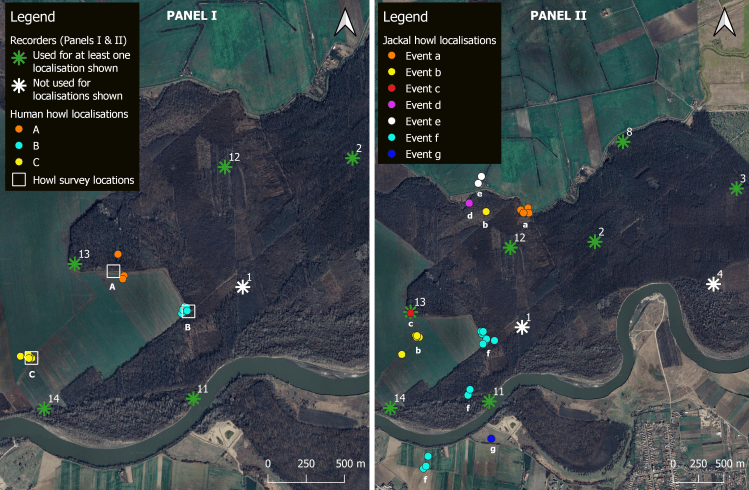
For this survey we deployed 10 recorders spaced 800-1000m from each other, over a 10 km2 area for seven nights. The recorders are called CARACALs and were designed by our colleagues at the University of Oxford. Because the CARACALs use GPS synchronisation, we were able to use the time difference in the arrival of recorded howls at different recorders to localise the source of the sound. In simple terms, this means we were able to pinpoint where the jackals were howling from.
We recorded jackal howls every night of the survey and successfully localised 27 jackal and 16 human howls, with human howls localised to within an average of 41 m of their actual location. The average distance between the recorders and estimated positions of vocalising jackals was just under 1 km, with howls detected from as far as 2.5 km away. However, some jackal howls were not detected clearly, or at all, on active recorders that were as little as 0.9 km away.
Based on these results, we recommend a conservative spacing of 0.8–1 km between recorders in future deployments, though this will depend on local environmental conditions. Overall, this study highlights acoustic localisation as a valuable tool for improving monitoring efforts and gathering more detailed data on jackal ecology. This information could significantly contribute to understanding their expanding range across Europe while informing the development of effective monitoring and management strategies for golden jackals. You can read the full paper here: https://doi.org/10.1002/ece3.71041.
Although this was just a short 2-week pilot study, the aim of this research was to develop an efficient and effective method for passive acoustic monitoring and acoustic localisation of golden jackals. With jackals rapidly spreading across Europe, this is an important development in jackal monitoring that will enable the early detection and tracking of dispersing individuals, as well as helping to answer behavioural ecology questions such as jackal habitat preferences and interactions with other species e.g. grey wolves.